Showing posts with label oil. Show all posts

Green Mac 'n' Cheese


Ingredients

1 tbs olive oil (plus more)
1 Leek
1.5 cups frozen, thawed spinach
1 tbs dry white wine
1 tbs flour
1 tsp granulated garlic
1/4 cup Gouda (I used goat milk Gouda)
1/2 cup Farm cheddar
1/4 cup black pepper Taleggio
2.5 cups skim milk
2 tbs low fat cream cheese
1 lb whole wheat pasta (I used penne)
1/2 cup shredded Italian blend or Asiago or Parm
S&P


How to make Green Mac 'n' Cheese


I made this on Halloween as a green treat for the man.  It came out so yummy, so even though it was an experiment and not supposed to go on the blog, I decided I had to take a picture and share it.

I was originally intending to put artichoke hearts in here, but when I went to look for them, they were no where to be found.  I'll be sure to have them on hand next time and add them to the mix!  Feel free to add whatever other veggies you like.  I tried to use healthy ingredients wherever possible since the cheese is so...er...delicious.


Start with a high edged saute pan or a sauce pan.  Heat oil over medium high head and add the light green and white parts of the leek (diced).  Season with salt, pepper, and garlic.  Saute until fragrant.  Add in the spinach and cook for about 4 minutes.  Add wine and cook for about 3 minutes more.

Meanwhile, cook pasta in heavily salted water until al dente.  Reserve about 2 tbs of the cooking water.

When the alcohol has burned off of the wine, add a bit of the pasta water, if needed.  Cook for about 2 minutes.

If the spinach mixture looks like it needs a bit more oil, feel free to add some.  You don't want it to be oily, but there does need to be some fat in the pan.  Then, whisk (or fork) in the flour, a little a time until the mixture is quite thick.  You do not want to brown the roux, so keep the heat low and stir constantly.  Then, add the milk a little a time.  Cook for about 4 minutes.  The sauce will thicken as it cooks.  Stir in the cream cheese and melt it. 

Remove the sauce from the heat and stir in the Gouda, Cheddar, and Taleggio until melted.  Then, pour over the pasta in a casserole dish and stir to coat all of the noodles.  Top with Italian blend and place under the broiler on "LOW" for about 5 minutes or until top cheese is crispy and brown.  Serve and ENJOOOOOY!!!

Cheese Herb Bread


 Ingredients

1 1/2 cups warm water
1 packet dry, active yeast
1 tsp sugar
3 1/2- 4 1/2 cups bread flour
1/2 cup Parmesan cheese (or other cheese) plus more for sprinkling
2 tbs olive oil
1 tbs Italian dried herbs
1/2 tsp salt


How to make Cheese Herb Bread


My new adventure in bread making has taken me to a place where I want to make quicker bread with yummy extras in it!

This is a much quicker recipe than my artisan herb bread and is perfect for sandwiches and snacks.  This bread takes a little bit of love though :)

Dissolve the yeast in the water and sugar.  Let stand about 10 minutes or until very foamy.  Mix in the flour and salt with your hands or a wooden spoon until pretty smooth.  Then, knead the dough for about 10-12 minutes or until shiny, stretchy, and smooth.  Add more flour if needed.

Shape the sough into a ball and put in a lightly oiled nonreactive bowl, turning to coat the dough on all sides with oil.  Cover with a towel and let stand for 2 hours.  The dough should be doubled in size.

Then, turn the dough out onto a floured surface. Knead in the cheese and herbs.  Cover with the towel and let rest another hour an a half.  Then, cut the dough in half and form into long loafs.  Cover and let rest another 10 minutes.

Preheat the oven to 350 degrees.  Top the bread with extra cheese (optional) and bake for about 30 minutes, or until the loaves sound hollow when thumped.

Enjoy!!

Vegetable Puree


Ingredients

1 medium onion
1 shallot
6-8 cloves of garlic
4 carrots
2-3 stalks of celery
2 small potatoes or 1 large potato
1 inch cube of fresh ginger (optional)
1/2 cup cabbage
3/4 tbs vegetable/olive oil
1/2 tsp celery salt
3 green onions
6 cups vegetable stock
S&P


How to make Vegetable Puree


This puree is so lovely and warming, no one will believe it is so easy to make.  I love purees because you don't have to worry about chopping as uniformly or cooking each vegetable perfectly.  Instead, you can just throw everything in a pot and let it boil away!

In a large dutch oven, heat oil over medium heat.  Add diced potatoes, carrots, celery, garlic, onions, shallot, ginger, salt and pepper.  Sweat for about 6-8 minutes until vegetables begin to color a bit.  Be sure not to burn the garlic.

Slowly pour in the stock, scraping the bottom of the pan with a spoon to pull up the yummy bits.

Bring to a boil and add in the cabbage, 3/4 of the green onions, and celery salt.  Reduce to a simmer and cook until all of the vegetables are very soft.

Puree with an immersion blender or a food processor in batches until smooth.  Taste and season with more salt and pepper accordingly.

Top bowls with remaining green onions and fresh cracked pepper.  Enjoy!

This is also a great soup for leftovers because nothing gets soggy or discolored.  I usually make it in such large batched because of that!


Challa Bread


In honor of Rosh Hashana, I thought I would try my hand at some Challa Bread!  This is something I had never made before, so I thought I would actually follow a recipe.  (Bread is a big time investment to have it not rise or something!!)

I found this pretty easy recipe on one of my favorite sites, Chow.  Don't let the many steps fool you; it's not actually that hard.


INGREDIENTS
For the bread dough:
1 cup warm water (about 105°F to 115°F)
2 (1/4-ounce) packets active dry yeast (4 1/2 teaspoons)
1 large egg, lightly beaten
2 large egg yolks, lightly beaten
1/4 cup vegetable oil, plus more for coating the bowl
1/4 cup plus 1 1/2 teaspoons granulated sugar
4 to 4 1/2 cups bread flour, plus more for dusting the work surface
2 teaspoons fine salt
4 teaspoons fine-ground cornmeal

For the egg wash and topping:
1 large egg, beaten
1 tablespoon water
Pinch salt
1 to 2 teaspoons poppy or sesame seeds (optional)


INSTRUCTIONS

For the bread dough:
  1. Place the warm water in a large bowl and sprinkle in the yeast. Let sit until foamy, about 5 minutes. Add the egg, egg yolks, measured oil, sugar, 4 cups of the flour, and the salt. Stir with a wooden spoon until the mixture comes together to form a shaggy dough and most of the flour is incorporated.
  2. Turn the dough out onto a lightly floured work surface and knead, adding more flour a little at a time if the dough is sticky or very soft (it should be firm). Knead until the dough is smooth and elastic (when you push down, the dough should feel firm and push back), about 10 to 15 minutes.
  3. Coat a large bowl with a thin layer of vegetable oil. Place the dough in the bowl, turn to coat in the oil, and cover with a damp tea towel or plastic wrap. Let rise in a warm, draft-free area until tripled in volume, about 40 to 60 minutes. When fully risen, an indentation made with a finger pushed into the center of the dough should remain; this is a fully aged, or ready, dough.  Punch down the dough, cover, and allow to rise for 15 minutes more.
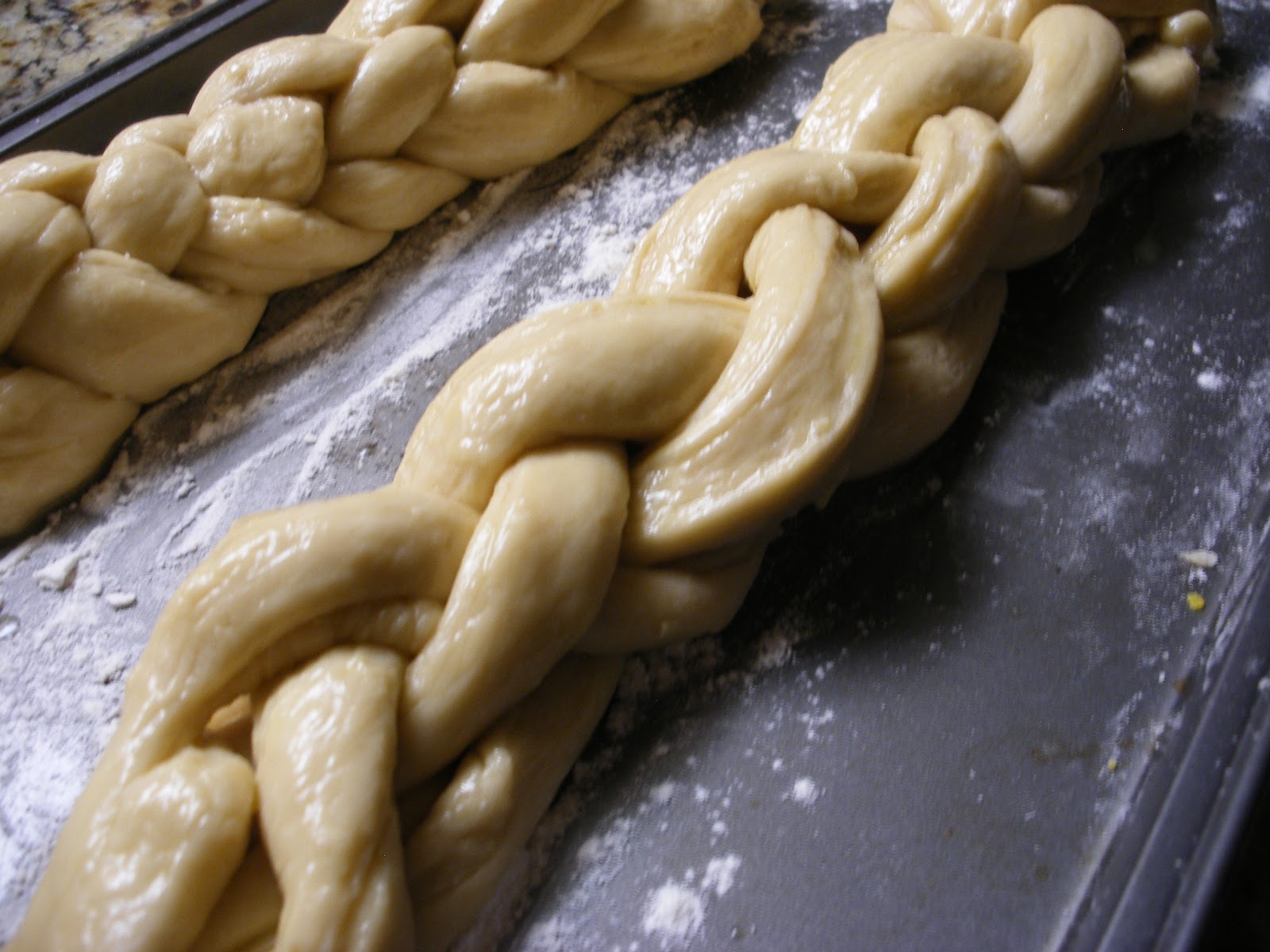
  4. Punch down again and cut into 2 equal portions. Cover 1 portion with a damp tea towel or plastic wrap; set aside. Divide the other portion into 6 equal pieces. On a work surface, use your palms to roll the pieces into 6 ropes that are thick in the center, tapered to a point on each end, and at least 12 inches long (lightly flour the work surface if the dough becomes too sticky or difficult to roll). Line up the 6 strands vertically and pinch the top ends together.
  5. Counting from left to right, bring strand number six from the right end over strand number one on the left and up to the left.  Bring strand number one from the left up to the top right. You now have a four-legged creature with two arms crossed over each other.  Keeping the legs spread apart in pairs, the left arm (as you face it) comes down into the center between the legs.
  6. Bring the outer right leg over and up to form a new top left arm.  The top right arm comes down between the legs.
  7. Repeat the pattern: The left outer leg comes up to form the new right arm, and the left arm comes down to the center. The right leg comes up to form the new left arm, and the right arm comes down to the center.
  8. Continue alternating (left leg up to become right arm, left arm down to the center; right leg up to become left arm, right arm down to the center, and so on), always keeping hold of the last strand you moved so that you remember your location in the pattern. When moving strands, grasp the arms by the ends where hands would be. Grasp the legs where feet would be. Keep the legs spread in pairs so that the arms can easily be brought down to the center. If you become momentarily disoriented when braiding, remember that the arms come down, and the legs come up. If you make an error and become entirely confused, stop, open the braid, and begin again. When done, if there is any doubt, turn the bread upside down. The design should be perfectly symmetrical. If not, undo it and begin again. Finish by pinching the ends tightly closed.
  9. Dust a baking sheet with the cornmeal. Transfer the challah to the baking sheet and repeat the process with the second portion of dough. Place the challahs in a warm, draft-free area and allow to rise until almost doubled in size, about 45 minutes.
For the egg wash and topping:
  1. Heat the oven to 350°F and arrange a rack in the middle.
  2. Combine the beaten egg, water, and salt. Brush both loaves with the egg wash, using care to cover them completely, but do not let any excess egg drip into the crevices. Let the loaves sit until dry, about 15 minutes, and then brush again. Sprinkle with poppy seeds or sesame seeds if desired.
  3. Bake the loaves, rotating the sheet halfway through the baking time, until they are a rich mahogany color and emit a hollow sound when tapped lightly on the bottom with your fingertips, about 35 minutes. If the tops begin to brown excessively and the bottoms are raw, cover the bread with a sheet of parchment paper or aluminum foil that has been creased down the center to form a tent. If there is a white line visible between the braids, continue baking until it disappears. To test for doneness, press lightly between the braids on the highest part of the bread; it should be firm. If you feel the creases give when lightly pressed, continue baking until they firm up. Let cool on a wire rack.
  4. Challah keeps very well for several days in a plastic bag in a breadbox. It can also be wrapped in plastic or foil and placed in a resealable freezer bag, frozen, and defrosted slowly overnight in the refrigerator.

    Pasta with Roasted baby Brussels

    Ingredients

    8 oz fresh, dry pasta
    2 cloves garlic, minced
    1 large shallot, minced
    1-2 tbs olive oil, divided
    1/4 cup dry white wine
    1/4-1/3 cup vegetable stock
    1 tsp lemon pepper (optional)
    1 pinch red pepper flakes
    6-8 grape tomatoes, halved
    Asiago and Parmesan cheese
    2 cups halved, baby Brussels


    How to make Pasta with Roasted Baby Brussels


    I happen to keep frozen baby Brussels from Trader Joe's in my freezer at all times, so I use those.  They work perfectly for when I'm craving that little bitter vegetable but they aren't in season.

    Preheat your oven to 400 degrees.  On a baking sheet, toss Brussels with oil, salt, and pepper.  Roast for about 10 minutes or until crispy.

    In a medium pot, bring some salted water with a pinch of red pepper flakes to a boil.  Add pasta and cook  slightly less time than the package directions.  If you are using fresh pasta, it will only take a few minutes to cook, so plan accordingly.  Reserve about 1/2 cup of the pasta water.

    In a large skillet, heat oil over medium heat.  Add garlic and shallot and cook about 3 minutes.  Slowly pour in the white wine and add the vegetable stock.  Reduce heat to medium low and cover.  Add the pasta, tomatoes, roasted Brussels, and a bit of the pasta water.  Stir and adjust the liquid to ensure that it is not too soupy but that there is enough sauce .

    Serve topped with cheese.  Enjoy!

    Potato Salad with Peas

    This was a HUGE hit for fourth of July.  People really liked the how tangy is was compared to other potato salads that have a lot of mayonnaise.


    Ingredients

    2.5 lbs Red potatoes
    2 stalks of celery
    4 green onions
    8 ounces of sour cream
    2 tbs mayonnaise
    1.5 cups frozen, thawed peas
    1 tbs stone ground mustard
    S&P


    How to make Potato Salad with Peas

    Boil the potatoes with the skin on until al dente.  Set aside and let cool for a bit.

    Then, cute the potatoes into bite-size pieces and mix with the other ingredients, also chopped into bit-size pieces.  Chill in the fridge for at least and hour to let the flavors come together.

    Serve and enjoy!

    Artisan Herb Bread

    I have been so tempted to make bread for a long time, but as someone who fancies herself more of a cook than a baker and a recipe maker rather than a recipe follower, I was less than optimistic about my potential skills.  However, after doing some research, I managed to come up with a recipe that I found to work very well.  It's easy, and pretty similar to the New York Times famous "No Knead Bread", though I found that a little kneading never hurt anyone :)

    For the bread, you can really put anything that you want in it, but I chose the herbs that I had on hand at the time.  Later, I made some with fresh rosemary, thyme, and oregano that was so delicious!!


    Ingredients

    4 cups of wheat flour
    1 1/2 cups warm water
    3/4 packet of dry active yeast (3/4 tbs)
    3/4 tsp sugar
    3/4 tsp salt (more if you like salty)
    2 tbs chopped basil
    1/2 tsp dried onion flakes
    1 tsp dried rosemary


    How to make Artisan Herb Bread


    This is a great bread recipe that turns out super crispy on the outside and airy in the middle.  I had never made bread before, so I surveyed some recipes and came up with this one.  Feel free to add whatever spices and herbs you want to the bread.  The next time I make it, I think I am going to put some cloves of garlic in it!

    Start by pouring the warm water into the yeast and sugar.  Let sit for about 20 minutes until it is a very bubbly mixture.  


    Then, add in the flour, salt, and herbs and mix.  You will have a very sticky, ugly looking dough. 
    Cover it with plastic wrap and let it sit for about 18-24 hours.  The mixture should look very bubbly.
    Take the mixture out of the bowl and carefully transfer to a floured working surface.  Form the dough into a ball and cover with a smooth, liberally floured kitchen towel while you preheat the oven.

    Preheat the oven to 450 degrees.  While preheating, put your pizza stone or baking sheet in there to warm up as well.  I let mine sit for an extra 10 minutes while the oven was heating the stone.
    Sprinkle the dough with some dried rosemary and transfer to the pizza stone.  (I put some aluminum foil between the stone and dough to make it easier to transfer and to ensure that it would not stick).  I also put a small ramekin full of water into the bottom of the oven to given a crispier crust to the bread.


    Bake at 450 degrees for about 1 hour, or until the bread is golden brown and crispy.  I used the toothpick trick to make sure the inside was properly cooked as well.

    Enjoy!!